

You're standing at a kitchen window at dusk when you hear a soft thump overhead. Outside, a raccoon is partway up the oak beside your house. It reaches a limb, walks toward the roof, and disappears near the eaves. Most homeowners blame the attic vent or chimney first. Start with the tree instead. When a raccoon climbing tree can reach your roofline, the tree isn't just a yard feature. It's the first link in your home's entry system.
Why Raccoons Climb Trees So Easily
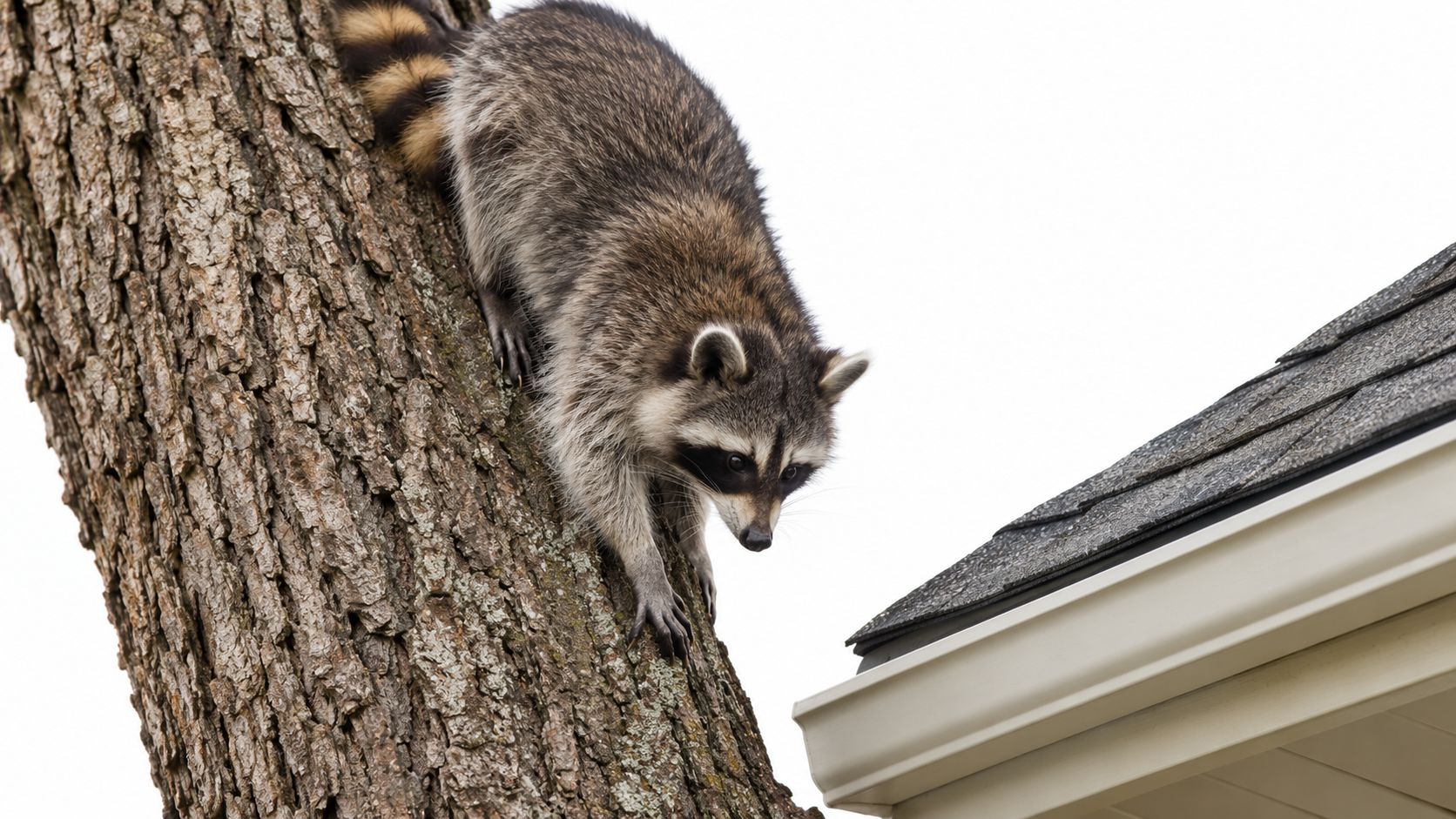
Say that raccoon hears your door open. It doesn't panic and back down the trunk tail first. It turns, points its head toward the ground, and climbs down facing forward. That smooth, fast descent tells you a lot about how its body works.
Feet built for bark
Each foot has five toes, and each toe ends in a short, curved claw that doesn't retract. Those claws stay out all the time, ready to catch on bark the way fingernails catch on a rough rope. The soles are naked and hairless, so the animal feels the surface directly and adjusts its grip as it moves.
The Washington Department of Fish and Wildlife species page explains that raccoons' hind feet can rotate approximately 180 degrees, which lets them descend head-first. That rotation is the detail many people miss. A raccoon doesn't have to reverse awkwardly down a trunk. It can watch where it's going, plant its hind claws behind it, and move quickly between a cavity, a branch, and the ground.
Balance and grip on narrow branches
The ringed tail works like a balance pole. On a thin limb, small tail movements help the raccoon stay centered while its claws hold the bark. Put the parts together and you get an animal that climbs like a person on a ladder wearing gloves that never slip.
That's why an ordinary fence rarely solves the problem. The same feet that grip bark also grip wood posts, wire, trellises, utility structures, and many building surfaces. A smooth barrier only helps if the raccoon can't reach around it, jump past it, or start climbing from something beside it.
Any surface a raccoon can climb is a potential route to the roof.
Climbing ability alone doesn't put a raccoon in your attic. It needs a reason to go up and a connected path from the tree to the building.
What Tree Features Draw Raccoons Up
Raccoons climb for two practical reasons. They want a safe, raised place to rest or raise young, and they want a quick escape from dogs, people, and other threats on the ground. A tree provides both. Height keeps them out of easy reach, and a hollow section offers shelter from rain, wind, and cold.
Use the screening profile below when you walk your yard.
| Feature | Raccoon-preferred range | What to check |
|---|---|---|
| Cavity opening width | About 4 to 10 inches | Measure with a tape. Openings in this range suit raccoons. |
| Height above ground | At least 15 feet | Higher cavities are harder to reach and more protected from weather. |
| Position in the tree | Below or within the canopy | Sheltered from rain and strong wind, so inspect the crown as well as the trunk. |
| Tree condition | Mature or dead trees with worn bark | Look for claw marks, bark scraping, and fresh droppings at the base. |
| Distance to the house | Limb touching or nearly touching the roof | A limb near the roof turns the tree into a route to the structure. |
The Virginia Tech Extension publication on wildlife cavities is the basis for the cavity measurements in the table. Read the rows as a screening checklist, not as proof that a tree is occupied. A hole can match every preferred dimension and still be empty, wet inside, or used by another animal. The last row matters most for your house. A cavity high in a tree on the far side of the yard is a habitat question, while that same cavity on a tree leaning into the roofline becomes an entry-system question.
How to read a tree on your property
Start at the base and work upward. Look for claw marks, bark that's worn smooth in vertical lines, and droppings near the trunk. Then measure any opening you can safely reach from the ground with binoculars and a tape estimate, and note whether branches lean toward the house.
A dead snag with a 6-inch hole high in the canopy fits the preferred profile closely, so treat it as a likely den site until you know more. Compare that with a mature maple that has a split trunk just above its lowest limb. The split may offer shelter even if it doesn't look like a neat round hole, especially if the opening stays dry.
The empty-looking cavity problem
Don't assume silence means nobody's home. In spring, a cavity that looks empty from the yard can hold a mother with young tucked deep inside. Sealing the hole or cutting the tree before checking occupancy can trap animals you can't see. If you hear faint chittering, scratching, or movement at dusk, stop and get the cavity assessed before you change anything.
How a Tree Becomes a Route to Your Roof
A raccoon prefers a connected path over an exposed walk. Crossing open lawn leaves it visible. Climbing a trunk, following a limb, and stepping onto shingles keeps it off the ground the whole way. That simple preference explains why one overhanging branch matters more than many homeowners expect.

The four links in order
First, the animal moves from the ground to the trunk. Second, it climbs to a limb that angles toward the building. Third, it crosses from that limb to the roof edge, gutter, or a lower roof section.
Fourth, it walks the roofline looking for a weak point. That may be an uncapped chimney, a gable vent, a loose soffit, or another attic penetration. A proper chimney rain cap installation closes one common endpoint, but the raccoon still reached the roof if the earlier links stay open.
Trees aren't the only connectors. The Michigan Department of Natural Resources raccoon guidance supports cutting limbs that overhang roofs and capping chimneys, and Connecticut DEEP identifies trees, downspouts, vines, and trellises as structures raccoons can use to reach roofs. A vine on siding can work like a ladder. A trellis beside the eaves can bridge the last gap. A nearby utility pole can do the same job as a trunk.
Check connections before openings
Map vertical and horizontal connections, not just holes in the house. Run these three checks first.
- Limbs over the roof: Note any branch that touches, overhangs, or nearly reaches shingles or gutters.
- Trunks near walls: Flag trees close enough that a raccoon can transfer from bark to siding, trim, or a downspout.
- Growth at the eaves: Look for vines and trellises that climb toward soffits and vents.
The common mistake is sealing the vent where scratching was heard and leaving the limb that delivered the animal. Another raccoon can use the same route next week. Every link you find needs attention, not only the opening you noticed first.
How to Block Tree Access to Attics and Roofs
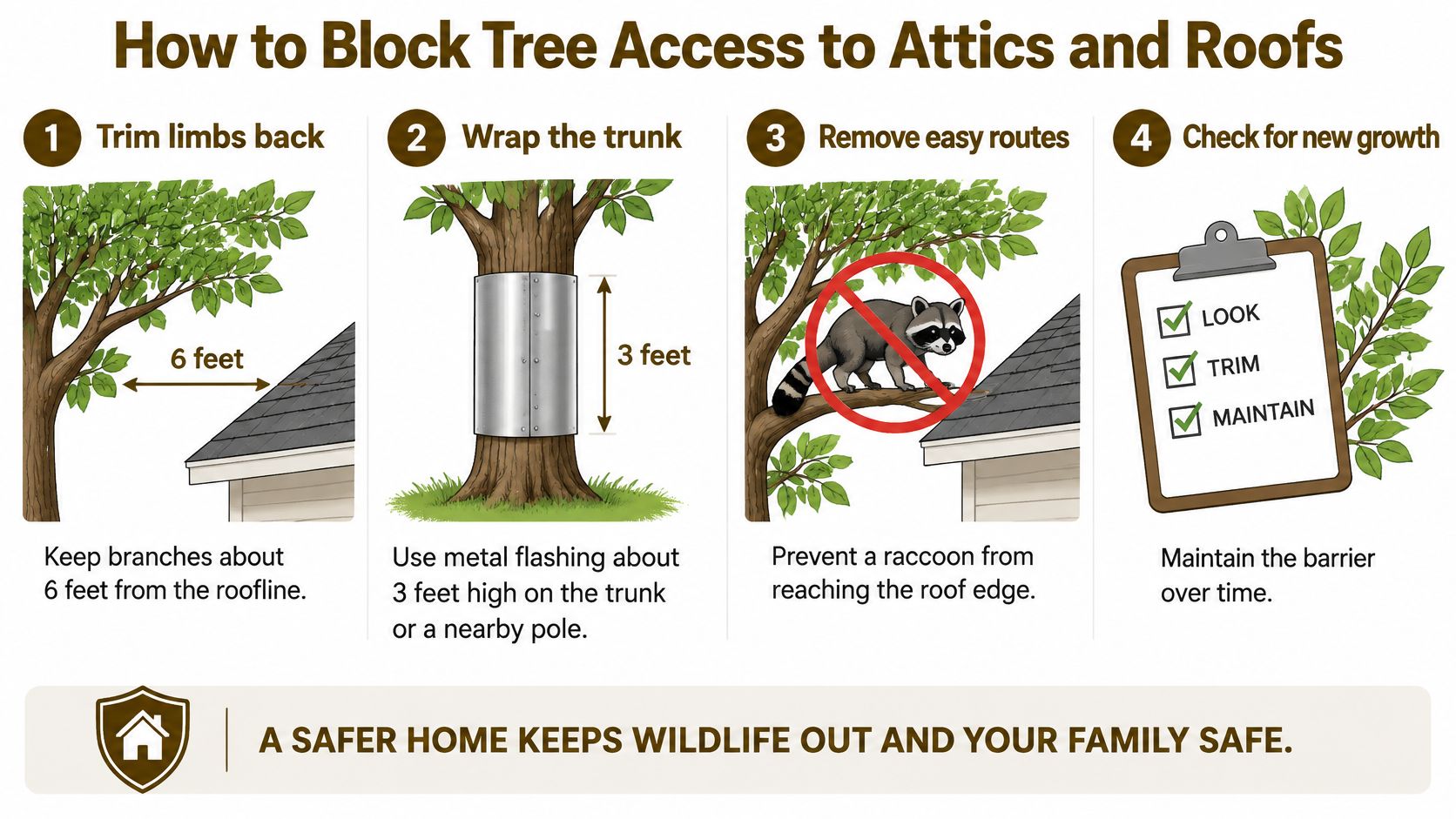
Work from the tree toward the house, then secure the roofline itself. You don't have to remove every tree in the yard. You do have to break the connected path and harden the places where a raccoon will test for entry.
A step-by-step exclusion plan
- Trim limbs back from the roofline. Cut branches so none touch the roof, and keep them about 6 feet away, because a touching limb is a direct bridge.
- Wrap the trunk or nearby pole. Install smooth metal flashing about 3 feet high around the trunk, because claws can't grip slick metal the way they grip bark. Keep the wrap tight and check that low branches don't let the animal bypass it.
- Remove plant ladders. Cut vines off siding and move or trim trellises near the eaves, because dense growth gives the animal both footing and cover.
- Cap the chimney. Use a sturdy mesh or metal cap that blocks animals while letting smoke escape, because an open flue resembles a hollow tree.
- Screen vents and soffit openings. Fasten 1/2-inch hardware cloth firmly over gable vents and other roof penetrations, because lightweight insect screen tears easily. A secure vent with screen setup needs solid fasteners, not loose staples the animal can pull.
- Recheck after storms and growth. Inspect at the start and end of each growing season, because new limbs, fallen branches, and torn screens reopen the route.
- Confirm the space is empty before sealing. Check the attic, chimney, and cavity for adults and dependent young, because a sealed opening can trap animals inside.
Before you seal anything: Confirm no raccoon or dependent young remains inside, and follow your state rules on trapping and removal.
Pay close attention to how soffits and fascia meet the roof edge, because small gaps there are easy to overlook from the ground. The roofline protection advice from Atomic Exteriors is useful background on what those parts do and why damaged sections deserve prompt repair. If trim is soft, cracked, or pulled away, fix the material itself rather than covering weak wood with screen and hoping it holds.
Don't treat one repair as the whole job. Sealing a single vent often pushes a persistent raccoon to test the next loose panel or roof joint. Trim the route, block the trunk, and secure every reachable opening as one connected project.
Home Damage That Starts Above the Ground
Damage from a climbing raccoon follows a chain. The tree is the entry point: it carries the animal up to the roof, and the roof leads to vents, soffits, and the chimney. One weak point at the end of that chain lets the raccoon inside, where cleanup becomes harder and more expensive. That is why the tree belongs on the same inspection list as the chimney cap and the attic vent, in the building's entry system rather than in the yard-work column.
The table below is a quick map of where that chain can end. The details under each risk come after it.
| Risk | Typical sign | Potential damage |
|---|---|---|
| Attic nesting | Noise overhead at dusk and dawn | Compressed, soiled insulation |
| Chimney denning | Sounds from the flue, odor at the fireplace | Blocked draft and smoke problems |
| Torn soffits and vents | Chewed or pulled-back screens | Water entry and rot in framing |
| Droppings in the attic | Latrine piles near vents or insulation | Roundworm eggs dangerous to people |
| Rabies exposure | Daytime wandering, unusual aggression | Direct contact risk |
Damage homeowners underestimate
Attic nesting flattens insulation wherever the animals walk and bed down. Urine and droppings soak into the material, and the odor can linger long after the raccoons are gone. Listen for heavy thumping rather than light scampering, mostly around dusk and dawn.
Chimney denning creates a different hazard. Nesting material and an animal in the flue can block draft, push smoke back into the room, and raise fire-safety concerns. Pay attention to scratching or chirping that seems to come from the fireplace, especially when it hasn't been used for a while.
Torn soffits and vents do double damage. Rain follows the same opening the raccoon used, and water reaches framing where it can't dry out. Watch for a soffit panel that's bent, displaced, or darkened after rain. If you find a pulled screen, also spot roof leak warning signs such as staining and damp trim before rot spreads.
Health risks need distance
Raccoon droppings can carry Baylisascaris roundworm eggs. Those eggs are hard to clean safely and can be dangerous to people, especially children who put hands in their mouths. Don't sweep a latrine with a broom or handle it with bare hands, because dry sweeping spreads contaminated dust.
Rabies is the other reason to keep your distance. A raccoon that's wandering in daylight, stumbling, or acting unusually aggressive shouldn't be approached or cornered. One animal passing through your yard in summer isn't the same situation as a family settled in an attic in spring. The second case needs careful, professional handling.
What to Do Now If a Raccoon Is Already Up the Tree
- Keep people and pets inside. Bring dogs and children away from the trunk, because a cornered raccoon may climb higher, jump, or defend itself.
- Watch from a window. Check at dusk and dawn, note when the animal leaves, and write down the exact route it takes.
- Listen indoors. Pay attention to thumping or scratching in the attic or flue, because repeated sounds may mean young are present.
- Don't force it out. Don't climb the tree, shake branches, spray water, or poke into a cavity. A startled animal can fall, bite, or retreat deeper into the house.
- Photograph the route. Take clear pictures of branch-to-roof contact, damaged vents, droppings, and entry points from a safe distance.
- Call promptly for strange behavior. If the raccoon is out in daylight, acting disoriented, or trapped where people must pass, keep away and contact a wildlife professional.
Your notes and photos will help you decide whether this is a passing visitor or an active den. They also make any discussion about the best way to remove raccoons more specific, because the professional can see the route before arriving.
When to Call a Professional Before You Act
A raccoon sitting in a tree is yard wildlife. A raccoon using that tree as a route onto your roof has become part of the building's entry system, and the response changes with it. Routine trimming and screening are reasonable do-it-yourself work while no animal is inside. The job shifts to a wildlife professional the moment a raccoon is already in the attic or chimney, you hear young, or you see daytime activity or aggression.
That line matters for a practical reason. Removing a mother without locating her young can leave babies trapped in a wall, flue, or attic corner. They cannot follow her out, and the result can be odor, insects, and a much harder cleanup. Because trapping rules are set at the state level, confirm Connecticut's current requirements with the Department of Energy and Environmental Protection before attempting any removal yourself.
Prepare before you call
- Location of sounds: Note whether noise comes from the attic, chimney, soffit, or a tree cavity.
- Route details: List which branches touch the roof and where vines, downspouts, or trellises connect.
- Photos and dates: Share entry-point pictures and the date and time of the last sighting.
Those three answers tell the technician where the route begins and whether work starts on a branch, at a vent, or inside the attic.
We provide trapping and removal of wildlife, such as raccoons and squirrels, in Northeast and Central Connecticut. One customer said our technician was at their door within an hour of a message, quickly assessed the raccoon situation, and removed all raccoons from their fireplace. You can start by calling 860-236-2683 to discuss the conflict you want resolved and whether the tree-to-roof route needs inspection before any sealing begins.
If a raccoon is using a tree to reach your chimney, vents, or attic, Wildlife Control Services, LLC can inspect the full route, remove animals that are already inside, and secure the openings they used. Don't seal the house until you're sure it's empty and the branch connection has been addressed. Visit Wildlife Control Services, LLC to request help with raccoon removal, chimney capping, vent screening, and long-term exclusion.
- All Posts
- Wildlife Blog


